

While Cappadocia’s fairy chimneys and hot air balloons steal the show, there’s a quieter, equally fascinating tradition that has shaped the region for centuries: the art of carpet weaving. More than just decorative items, these handwoven textiles are a vibrant tapestry of history, culture, and personal stories.
A Tradition Woven Through Time
The history of carpet weaving in Anatolia, and specifically in Cappadocia, dates back to ancient times. This craft was brought to the region by Turkic tribes migrating from Central Asia, who used carpets for both practical and symbolic purposes—as insulation for their nomadic tents, as floor coverings, and as a form of portable wealth.
This art form reached its peak during the Seljuk and Ottoman empires. The soft, volcanic-rich soil provided ideal grazing land for sheep, while the local rivers and plants were a source of natural dyes, creating a perfect environment for this craft to flourish. Weaving became a skill passed down from mother to daughter, with each generation adding its own unique touch.
The Language of Knots: Symbols and Meanings
Every knot in a Cappadocian carpet tells a story. The weavers, often women, used intricate motifs to express their hopes, fears, and emotions, turning each carpet into a personal diary. The designs, often geometric and stylized, are steeped in ancient symbolism:
- Ram’s Horn (Koçboynuzu): A symbol of strength, fertility, and masculinity.
- Hands on Hips (Elibelinde): A motif representing fertility, motherhood, and the female form.
- Tree of Life: Represents eternity, continuity, and the connection between heaven and earth.
- Amulet (Muska): A triangular shape believed to ward off the evil eye and bring protection.
The colors also have deep meaning, with red symbolizing wealth and nobility, blue representing hope, and green signifying immortality.
Weaving in the Modern Day
Today, the tradition of carpet weaving continues to be a vital part of Cappadocia’s culture and economy. The town of Avanos, famous for its pottery, is also a renowned center for carpets. Many workshops in Avanos and other towns in the region invite visitors to watch demonstrations, where skilled women weave intricate patterns on traditional looms.
The carpets are primarily made using wool, cotton, and sometimes silk, with the double-knot, or “Turkish knot,” technique ensuring durability and a tight, rich texture.
When you visit a carpet shop in Cappadocia, you’re not just buying a souvenir; you’re acquiring a piece of history and a work of art that carries the stories of its weaver and a timeless cultural heritage. It’s a connection to the very soul of this magical region.
The Difference: Kilims vs. Carpets
While the terms are often used interchangeably, there is a distinct difference between the two:
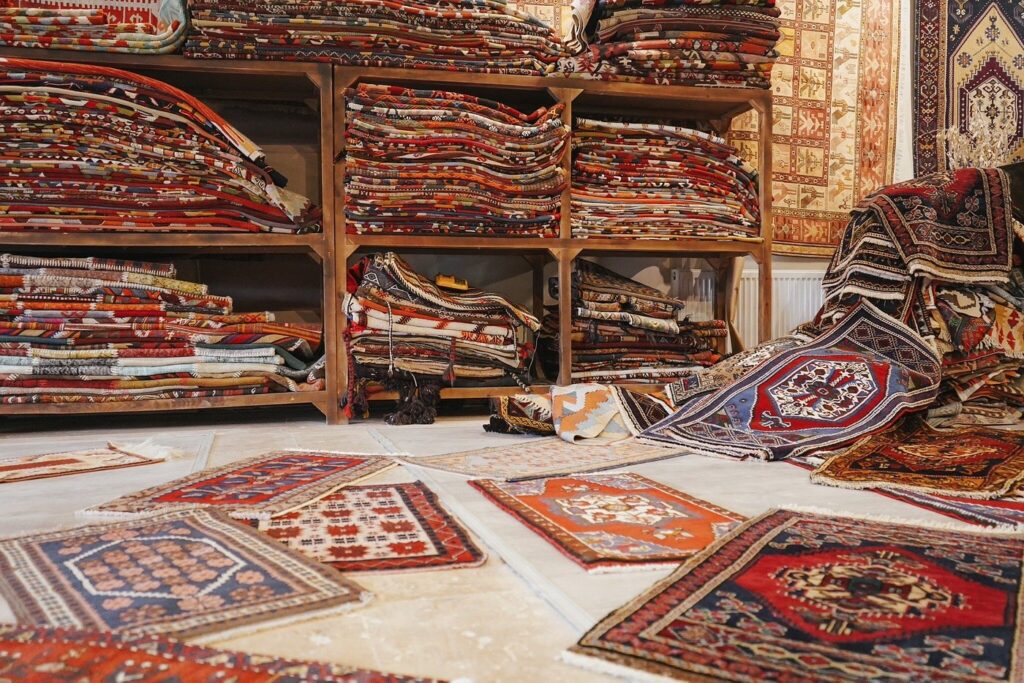
- Kilim: A kilim is a flat-woven textile. It has no pile and is created by tightly interweaving the warp and weft threads. Kilims are known for their geometric, often tribal motifs and are reversible. They are typically used as floor coverings, wall hangings, and even prayer mats.
- Carpet (Halı): A carpet is a pile-woven textile. Its production involves tying individual knots onto the warp threads. This process is far more labor-intensive and results in a thicker, denser fabric. Carpets are prized for their intricate, detailed designs and are generally more expensive due to the skill and time required to make them.
A Deeper Look into the Cultural Significance
In traditional Anatolian life, a carpet was far more than just a floor covering; it was a central part of a family’s life and identity.
- Dowry Item: For centuries, young women would spend years weaving carpets as part of their dowry. These pieces were a testament to their skill and a form of personal expression, with symbols representing their hopes for a happy marriage, family prosperity, and good fortune.
- Social Status: The number, quality, and size of a family’s carpets were often a sign of their wealth and social standing.
- Community: The communal weaving process in villages was a social event, a time for women to gather, share stories, and pass on their knowledge to younger generations. This tradition still exists today, keeping the craft alive.
A Guide to Buying Authentic Carpets
If you plan to purchase a carpet in Cappadocia, here are some tips to ensure you are getting an authentic, high-quality piece:
- Check the Knots: A true handmade carpet will have slight irregularities in its knots and an unevenness to its pattern. If the knots are perfectly uniform and the pattern is flawless, it might be machine-made. You can often see the knots on the back of the carpet; a denser, more intricate pattern of knots on the back signifies higher quality.
- Feel the Material: A genuine, high-quality wool or silk carpet will feel soft and luxurious. Be cautious of carpets that feel stiff or have a plastic-like texture, as they may contain synthetic materials.
- Examine the Dyes: Traditional Turkish carpets use natural dyes, which produce muted, harmonious color tones. While modern carpets may use synthetic dyes, a deep, rich color that doesn’t bleed is a good sign of quality.
- Don’t Rush the Process: The process of buying a carpet in Turkey is a cultural experience in itself. Don’t feel pressured to make a quick decision. Take your time, enjoy the traditional tea offered by the merchant, and listen to the stories behind the different pieces.


Recent Comments